Product Journal #16: Day, night and dynamic weather on planets; realistic textures
·2 min read·nLink team

Product Journal · part 16 of 20All parts
- 1.the nLink core and its add-ons
- 2.The short link core and the journey of a click
- 3.Bekçi, the security layer for short links
- 4.Share cards, QR codes and the bio page
- 5.Analytics and growth tools
- 6.nLink for teams and developers
- 7.Link Universe, your links become planets (beta)
- 8.Live activities in the universe, space football and flying car races
- 9.Live stream holograms on planets, relayed to Twitch, YouTube and Kick
- 10.Parental controls for accounts of under-18s
- 11.Two ships, Âfâk and Kristal; waking in the pod and walkable rooms
- 12.Four games you play with your ship; Rescue, Courier, Orbit Slingshot and Asteroid Mining
- 13.Games on planets; Sudoku Planet, Mushroom Planet and Slime Workshop
- 14.Fading Stars, digital literacy through play
- 15.Design your planet; look studio, identity, surface editor and buildings
- 16.Day, night and dynamic weather on planets; realistic textures
- 17.The Link Universe is open to all; guest pilots and playing on phones
- 18.Core updates; daily site analytics, cookie choice and a new Bekçi rule
- 19.Seyyah (Eren); a new game of Anatolian legend and Sufi lore in the Link Universe
- 20.Cutscenes, automatic travel and neighbouring planets in the sky
Planet surfaces are no longer a static scene. The sun moves, the weather changes and the game responds. All of it is computed from the planet and the clock, with no server needed: everyone who lands on the same planet at the same time sees the same sky.
Day and night
- Each planet has its own day (17–31 minutes). The display at the top left shows the planet's time.
- Morning and evening glow, moonlight and stars at night. Soft clouds drift with the wind.
Weather
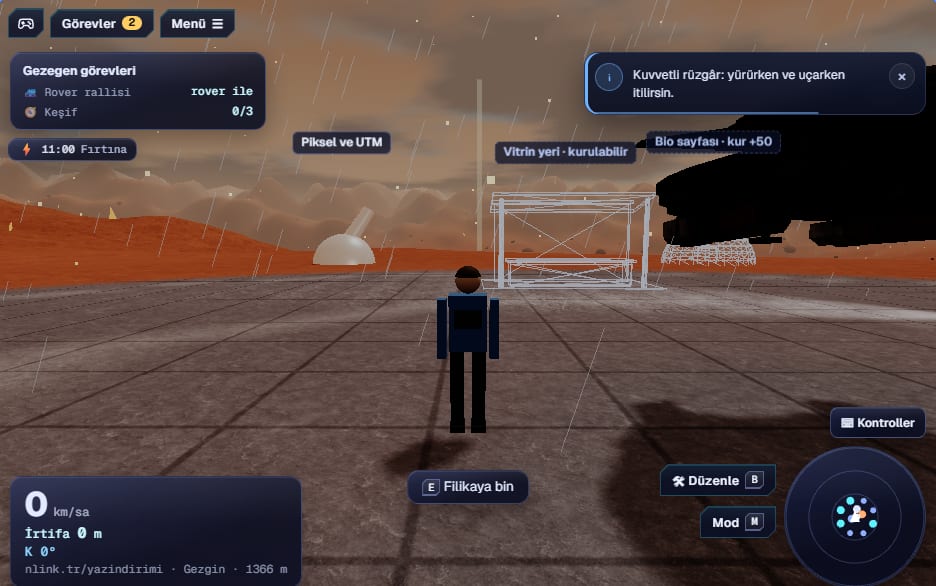
- Clear, partly cloudy, overcast, rain, storm and fog. By climate: snow and blizzards on cold planets, dust storms on Mars-like planets, haze and ash fall on hot planets. Planets without an atmosphere have no weather.
- The weather changes every 10–20 minutes with a smooth transition; a storm never jumps out of a clear sky, clouds gather first.
- Rain, snow, dust and ash particles; visibility drops in fog and precipitation; storms bring lightning and swaying trees. Rain, wind and thunder have sound too.
Weather changes the game
- Wind: in storms, blizzards and dust storms you walk slower against the wind and get pushed sideways. The shuttle and the flying car drift and wobble in the air; a nearby lightning strike shakes you.
- Slippery ground: rain wets the ground, snow covers it. The rover and the car slide in corners and need longer to stop. When it stops raining, the ground dries slowly.
- Landing: entering a stormy planet's atmosphere brings turbulence and lightning inside the clouds.
The same weather from space
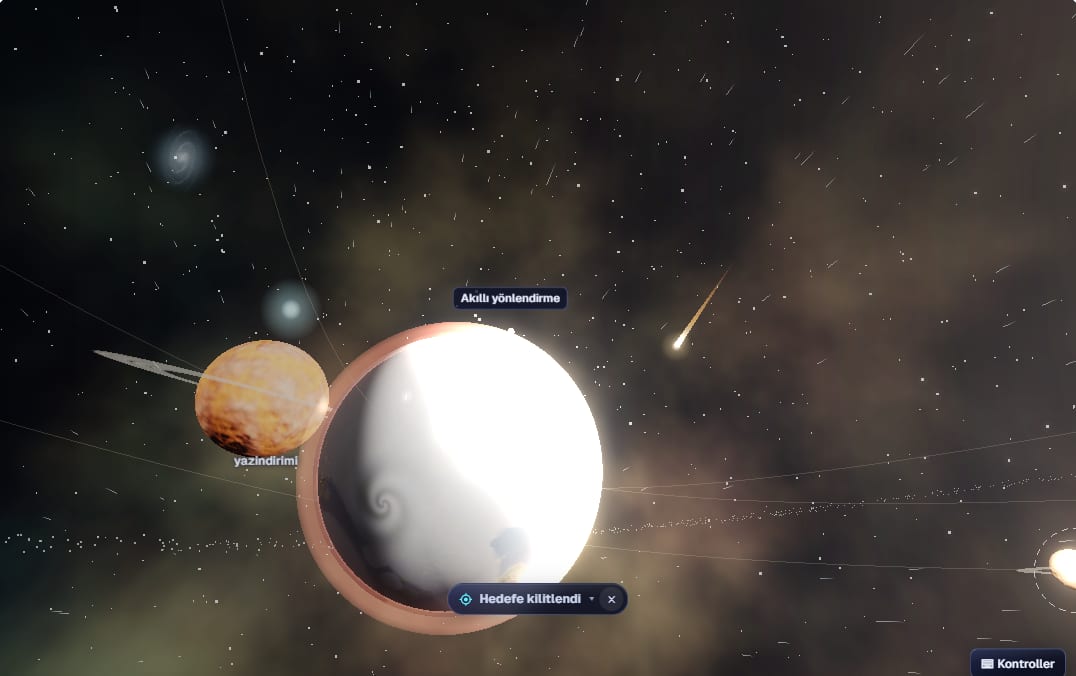
Seen from space, a planet's clouds show the surface weather: overcast skies thicken the cover, storms and dust storms turn an eyed spiral, and on the night side lightning flashes inside it. On planets with structures, city lights glow on the night side, the sea glints in the sun, and clouds and rings cast shadows.
Realistic textures
- Photo-textured ground: grass, soil, rock, snow and sand blend by slope, height and lake shore. Lakes, glass and marble reflect the sky.
- Vehicles were redone: lacquered bodies, tinted glass you can see through, treaded tires, five-spoke wheels.
- Metal plates and brushed steel inside the ship; wood in the Slime Workshop, real grass on the football pitch, an asphalt look on the race track.
- On phones textures are simplified to keep the frame rate; on computers the high setting shows full detail.